

Abstract: The curved jaw flexible coupling, recognized as a high-performance elastomeric coupling, holds a significant position in modern industrial drive systems due to its exceptional misalignment compensation capabilities, damping characteristics, and maintenance-free advantages. This paper systematically elaborates on the working principle, structural features, and mechanical model of the curved jaw coupling from the perspectives of engineering mechanics and materials science. An in-depth analysis is conducted on the material properties, fatigue mechanisms, and impact on the dynamic response of the transmission system of its core component—the polyurethane (or other material) elastomeric spider. Furthermore, the manufacturing processes and quality control standards are detailed. Based on extensive engineering practice, guidelines for selection and application across various industrial sectors, prominent advantages, and critical operational precautions are summarized. This research aims to provide engineers and technicians with a complete knowledge framework, from theory to practice, for this type of coupling, to optimize drive system design and enhance equipment reliability.
Keywords: Curved Jaw Coupling; Drive System; Misalignment Compensation; Polyurethane; Vibration Damping; Finite Element Analysis (FEA)
1. Introduction
In rotating mechanical drive systems, couplings are critical components for connecting two shafts and transmitting torque. Due to manufacturing tolerances, installation inaccuracies, thermal expansion during operation, and foundation settlement, relative displacement (collectively termed "misalignment")—radial, angular, and axial—between connected shafts is inevitable. Rigid couplings cannot compensate for these deviations, leading to significant additional loads on bearings, shafts, and seals, thereby accelerating equipment failure. Consequently, flexible couplings with compensation capabilities and shock absorption/damping functions were developed.
The Curved Jaw Flexible Coupling, also known as a "curved jaw coupling" or "jaw coupling," ingeniously incorporates a highly flexible non-metallic element (the star-shaped spider) between the curved jaws of two metal hubs. This design not only facilitates efficient torque transmission but also excellently compensates for various misalignments and absorbs shock energy. This paper aims to provide a comprehensive academic and engineering discussion on this topic.
2. Working Principle and Structural Analysis
2.1 Basic Structure and Components
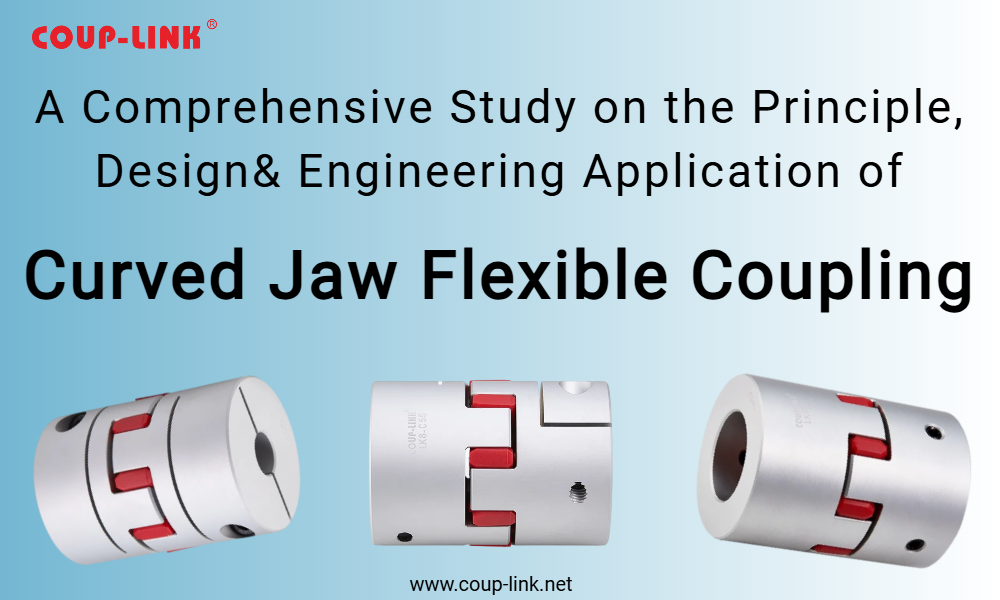
A typical curved jaw coupling consists of three basic components:
Two identical metal hubs: Typically made of aluminum alloy, stainless steel, or steel. The outer periphery of each hub features several (commonly 6-8) radially protruding, curved "jaws" uniformly distributed around the circumference. The profiles of these jaws are often based on an involute or other optimized curve.
A star-shaped elastomeric spider (Flexible Element): Made from elastic materials such as Polyurethane (PU), Nitrile Butadiene Rubber (NBR), or Hydrogenated Nitrile Butadiene Rubber (HNBR). Its shape is star-like, with each "lobe" side contoured to fit precisely with the curved jaw profile of the hubs.
The three components are assembled via an interference fit or light pre-compression, with the spider sandwiched between the jaws of the two metal hubs.
2.2 Torque Transmission and Misalignment Compensation Principles
Torque Transmission: When the drive-side hub rotates, its jaws transmit force by compressing the sides of the spider's lobes. The spider, in turn, transmits this force to the jaws of the driven-side hub through the opposite sides of its lobes, thereby transmitting torque. The process relies on the shear and compressive deformation of the elastomer.
Misalignment Compensation Mechanisms:
Radial Misalignment Compensation: When radial offset exists between the shafts, the spider is further compressed on the compression side and undergoes recovery or tensile deformation on the opposite side, absorbing the offset through its elastic deformation.
Angular Misalignment Compensation: When the shafts are at an angle, the compression between the jaws and the spider fluctuates cyclically during rotation. The spider accommodates the angular change through non-uniform deformation.
Axial Misalignment Compensation: The coupling design allows for limited relative axial movement between the two hubs, with the spider deforming axially to accommodate the displacement.
The unique "curved jaw" design is the key. Compared to straight jaw designs, the curved contact surface provides superior stress distribution. When angular or radial misalignment occurs, the contact surfaces allow for smooth sliding and rolling, reducing stress concentration and significantly minimizing wear and heat generation in the spider, thereby extending service life.
2.3 Mechanical Performance Analysis
The torsional stiffness of the coupling is non-linear. Below the rated torque, it primarily exhibits linear elasticity, ensuring transmission accuracy; during overload, the stiffness increases, providing a degree of overload protection. Its dynamic performance, such as torsional vibration damping, stems mainly from the internal damping (hysteresis loss) of the elastomeric material. By establishing a constitutive model for the elastomer, Finite Element Analysis (FEA) software can be used to accurately simulate the stress-strain state of the coupling under various operating conditions, optimizing the jaw curve and spider geometry to achieve optimal fatigue life and compensation capacity.
3. Materials Science and Manufacturing Processes
3.1 Elastomeric Spider Material
The properties of the spider directly determine the coupling's core performance metrics.
Polyurethane (PU): The most common material. Offers high tensile strength, abrasion resistance, tear resistance, and good oil resistance. Available in a wide range of hardness (e.g., Shore A 80-98), allowing formulation to meet different torque and stiffness requirements. Drawbacks include relatively limited resistance to high temperatures (typically up to 90-110°C) and hydrolysis.
Nitrile Rubber (NBR) and Hydrogenated Nitrile Rubber (HNBR): Suitable for applications demanding higher oil resistance, temperature resistance (HNBR up to 150°C), such as automotive and petrochemical industries. Their damping characteristics are often superior to PU.
Other Materials: Such as polyesters, used for special conditions (e.g., food-grade, high chemical resistance).
Material selection requires comprehensive consideration of torque, speed, ambient temperature, and media (oil, water, chemicals).
3.2 Hub Materials and Manufacturing
Hubs are typically made from Aluminum Alloy (lightweight, high thermal conductivity), Steel (high strength, high torque), or Stainless Steel (corrosion resistance). Manufacturing processes include:
Aluminum/Steel: Precision casting or CNC machining (turning, milling) to ensure geometrical tolerances and surface finish of the jaws.
Stainless Steel: Primarily machined.
All metal components undergo appropriate heat treatment (e.g., solution treatment and aging for aluminum, quenching and tempering for steel) to enhance strength and dimensional stability, and surface treatment (e.g., anodizing, zinc plating, painting) to improve corrosion resistance.
3.3 Spider Manufacturing
The primary manufacturing process is injection molding. Granular or liquid rubber/polyurethane material is injected into a precision mold and vulcanized or cured under specific temperature and pressure. The precision of mold design and control of process parameters (temperature, pressure, time) are crucial for the internal and external quality of the final product.
4. Engineering Applications and Selection Guidelines
Curved jaw couplings are widely used in:
Connections between servo motors and ball screws/gearheads: Requiring high-precision positioning and zero or low backlash.
Connections between variable frequency drives and pumps/fans: Cushioning starting shocks and compensating for installation misalignment.
Material handling equipment: Such as conveyors, mixers.
Packaging, printing, and textile machinery and other applications demanding smooth transmission.
Selection Criteria:
Torque: Calculate the system's rated torque and maximum torque (peak torque, stall torque). The coupling's rated torque must include a safety factor.
Speed: Ensure the operating speed is below the coupling's maximum allowable speed to prevent spider failure due to centrifugal forces.
Misplacement Capacity: Based on estimated radial, angular, and axial misalignments, select a coupling size with adequate compensation capability.
Environment: Consider temperature, humidity, oil, dust, and other environmental factors to select the appropriate spider material.
Moment of Inertia: For high-dynamic-response servo systems, select couplings with low inertia to reduce system load.
5. Advantages and Limitations
5.1 Key Advantages
Excellent Misalignment Compensation: Capable of simultaneously compensating for combined misalignments.
Good Vibration Damping and Shock Absorption: Protects both driving and driven equipment.
Electrical Insulation: The spider isolates electrical current between shafts, preventing electro-corrosion.
Lubrication-Free, Low Maintenance: Reduces operating and maintenance costs.
Zero or Low Backlash: Suitable for high-precision motion control.
Low Weight and Low Moment of Inertia: Particularly suitable for high-speed and frequent start-stop applications.
Overload Protection: Under extreme overload, the spider fails first, protecting more expensive equipment.
5.2 Limitations
Limited Temperature Resistance: Constrained by the elastomer material, not suitable for extreme high-temperature environments.
Chemical Resistance: Certain elastomers are susceptible to specific chemicals (e.g., strong acids, bases, ketone solvents).
Torque Capacity: Compared to diaphragm or gear couplings, the transmitted torque capacity is relatively lower.
Aging: Elastomeric materials age over time, leading to gradual performance degradation.
6. Operational Precautions and Fault Diagnosis
Correct use is critical for ensuring long coupling life.
Accurate Alignment: Although capable of compensating for misalignment, good initial alignment (minimizing residual misalignment) is the most effective way to extend spider life.
Avoid Overload: Operate strictly within selection guidelines; avoid prolonged overload operation.
Environmental Control: Avoid use in environments exceeding the spider's tolerance for temperature, UV exposure, or chemicals.
Installation: Never use hammers or violent methods for installation, as this can damage the spider or hub jaws. Use recommended installation tools.
Regular Inspection: Establish a routine inspection schedule. Check the spider for signs of cracking, hardening, permanent set, or excessive wear. Replace immediately if any are found.
Common Failure Modes:
Spider Fracture/Tearing: Usually caused by severe overload, extreme misalignment, or fatigue aging.
Excessive Spider Wear: Primarily due to prolonged operation under significant misalignment or contamination by grease.
Spider Hardening/Chalking: Caused by aging due to high temperature, ozone, or chemical attack.
7. Conclusion and Future Outlook
The curved jaw flexible coupling, with its compact design, excellent performance, and cost-effectiveness, has become a preferred coupling choice for low to medium-power drive systems. Its core technology lies in the perfect combination of curved jaws and high-performance elastomers, achieving a balance between mechanical performance and misalignment compensation capability.
Future developments for this technology will focus on:
New Material Development: Researching new elastomeric materials with wider temperature ranges, higher wear resistance, and better chemical resistance.
Structural Optimization: Utilizing topology optimization and additive manufacturing to design lighter, higher-performance hub structures.
Smart Integration: Incorporating sensors to monitor torque, temperature, and vibration in real-time, enabling predictive maintenance.
Standardization and Customization: While standard series meet most needs, providing highly customized solutions for special industries (e.g., aerospace, medical devices).
In summary, a deep understanding of the intrinsic mechanisms of the curved jaw flexible coupling and its correct application are of significant practical importance for enhancing the reliability, efficiency, and service life of entire drive systems.

<rt id="u4ag4"></rt>
<rt id="u4ag4"></rt>